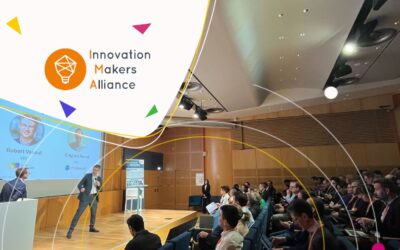
Artificial intelligence and user-centered design have become essential levers for modernizing public services. During the Acteurs Publics Solutions program on September 17, Robert VESOUL, CEO of ILLUIN Technology and Co-director of CentraleSupélec's Digital Innovation Chair, discussed this crucial topic with Renaud MONNET, Director of CentraleSupélec's Digital Lab, and Juan d'ALCANTARA, Director of Development at Majorel France. Discover their vision and explore how AI and design can improve the efficiency and accessibility of public services, while emphasizing the importance of acculturation, prototyping and an iterative approach.
AI, levers for transforming public service
Artificial intelligence plays a central role in the transformation of public services. It not only makes services more efficient, but also enhances the quality of the user experience. One of the key points raised by the experts is that AI should not be perceived solely as a technological advance, but as an engine capable of rethinking interactions between administrations and citizens. Thanks to AI systems, administrations can better analyze data, anticipate user needs and personalize their services.
However, AI alone is not enough. For it to have a real impact, it needs to be integrated into a broader approach, where the user is placed at the center of concerns.
The Aristotle project is an excellent example of this. This program, which uses AI to personalize learning paths in the field of education, demonstrates how AI can be used to meet the specific needs of students by providing content tailored to their learning level and pace. This logic of personalization through AI could be extended to public services to offer solutions better adjusted to the expectations and particularities of each citizen.
User-centered design: an indispensable complement
This is where user-centered design comes in. As Robert VESOUL and his colleagues emphasized at the conference, AI and design need to work in a complementary way. User-centered design makes it possible to design public services tailored to the real needs of citizens. It's about going beyond the simple implementation of technologies and completely rethinking the user experience, simplifying access to services and making them more intuitive.
This AI-design duo can radically transform public services, moving from fixed, inefficient models to agile systems that constantly adapt to user expectations.
Mobilizing top management: a decisive factor
Another fundamental point raised by Robert VESOUL is the importance of mobilizing decision-makers within administrations. Indeed, the transformation of public services can only succeed if top management is actively involved. It's essential that public service leaders take ownership of the challenges of AI and design to drive profound change.
Without this strategic involvement, innovation initiatives run the risk of remaining pilot projects, with no real impact on the ground. To guarantee a lasting transformation, decision-makers must not only support these projects, but also encourage a culture of innovation within their teams.
Acculturation to AI: a prerequisite for success
One of the key factors in the success of this transformation is theacculturation of teams to new technologies and design practices. As the speakers emphasized, it is essential that all stakeholders understand the challenges and opportunities associated with AI and design. This requires training, awareness-raising and clear communication on the benefits and uses of these innovations.
Acculturating teams helps to avoid obstacles linked to unfamiliarity or fear of change, while promoting faster, smoother adoption of new practices within public administrations. The aim is to make AI and design familiar tools, used by all as part of their daily missions.
Prototyping and the iterative approach: from idea to reality
One of the key points emphasized by Renaud MONNET and Juan d'ALCANTARA at the conference was the need for prototyping. Before deploying solutions on a large scale, it is essential to test ideas in real-life conditions, through prototypes. These prototypes enable concepts to be validated, solutions to be adjusted in line with user feedback, and potential obstacles to be identified.
Prototyping favors an iterative approach, where solutions are adjusted and perfected progressively. Rather than seeking to transform everything at once, the idea is to move forward step by step, evaluating each stage. This method limits risks, while guaranteeing solutions that are more effective and better adapted to users' real needs.
The importance of partnerships in accelerating innovation
Innovation in public services cannot be achieved without collaboration. That's why initiatives like CentraleSupélec's Paris Digital Lab, co-directed by Robert Vesoul, play a crucial role. This type of partnership makes it possible to cross-fertilize private and public sector expertise, and experiment with innovative solutions in real-life conditions.
These innovation ecosystems facilitate the integration of AI and design into public services, while ensuring that the solutions developed meet the specific challenges of the public sector.
Conclusion
To successfully transform public services, AI and design must be at the heart of the strategy. AI offers powerful solutions for improving the efficiency and personalization of services, while user-centered design guarantees an experience tailored to citizens' real needs. However, without strong involvement of top management, acculturation of teams, and an iterative approach based on prototyping, these technologies risk not reaching their full potential.
At ILLUIN Technology, we firmly believe that this alliance between AI, design, acculturation and iterative strategy is the key to modernizing public services and offering smarter, more accessible services to all.