Why this white paper?
nAIxt Consulting's contribution: GenAI definitions and challenges
AI is the use of machines to reproduce reasoning from data. Generative AI, on the other hand, is a subset of AI whose production (text, image) is original, i.e. no one has created this content before. Applied to customer relations, generative AI will, for example, open up new possibilities for personalization. Better than any human, it is capable, during a conversation, of adapting to the customer, of focusing on a problem, but also of going further in the response. It is this power of personalization and understanding of the customer that will make the difference in the relationship with a brand, all the more so as it enables a much more natural and simpler mode of interaction than an FAQ, a complaint form or an e-mail.
Beyond the conversational domain, generative AI opens up new perspectives in multiple directions: understanding the reasons for complaints, sentiment analysis, data extraction from documents, redirection of incoming call flows, etc. "Alexander Micrklewright, Director of AI Strategy & Innovation at ILLUIN Technology and nAIxt Consulting, explains : "The most underestimated potential of generative AI is its ability to perform tasks that were previously carried out by other AIs. "This could be, for example, extracting all the sender information from an e-mail, processing images and attachments, verifying an ID, and so on. What also makes a difference is processing customer reviews or summarizing a conversation. Algorithms have changed the way we handle these types of tasks, and this is where we're going to see a real acceleration."
The challenge now is to industrialize AI projects and generate ROI, while controlling the risks associated with the new models - hallucinations, cognitive biases, prompt attacks, etc. - and ensuring that they have a positive impact on employees, customers, society and the world around us. - and ensuring a positive impact on employees, customers, society and the world around us.
ILLUIN Technology's contribution: 5 GenAI use cases for Customer Relations and Marketing
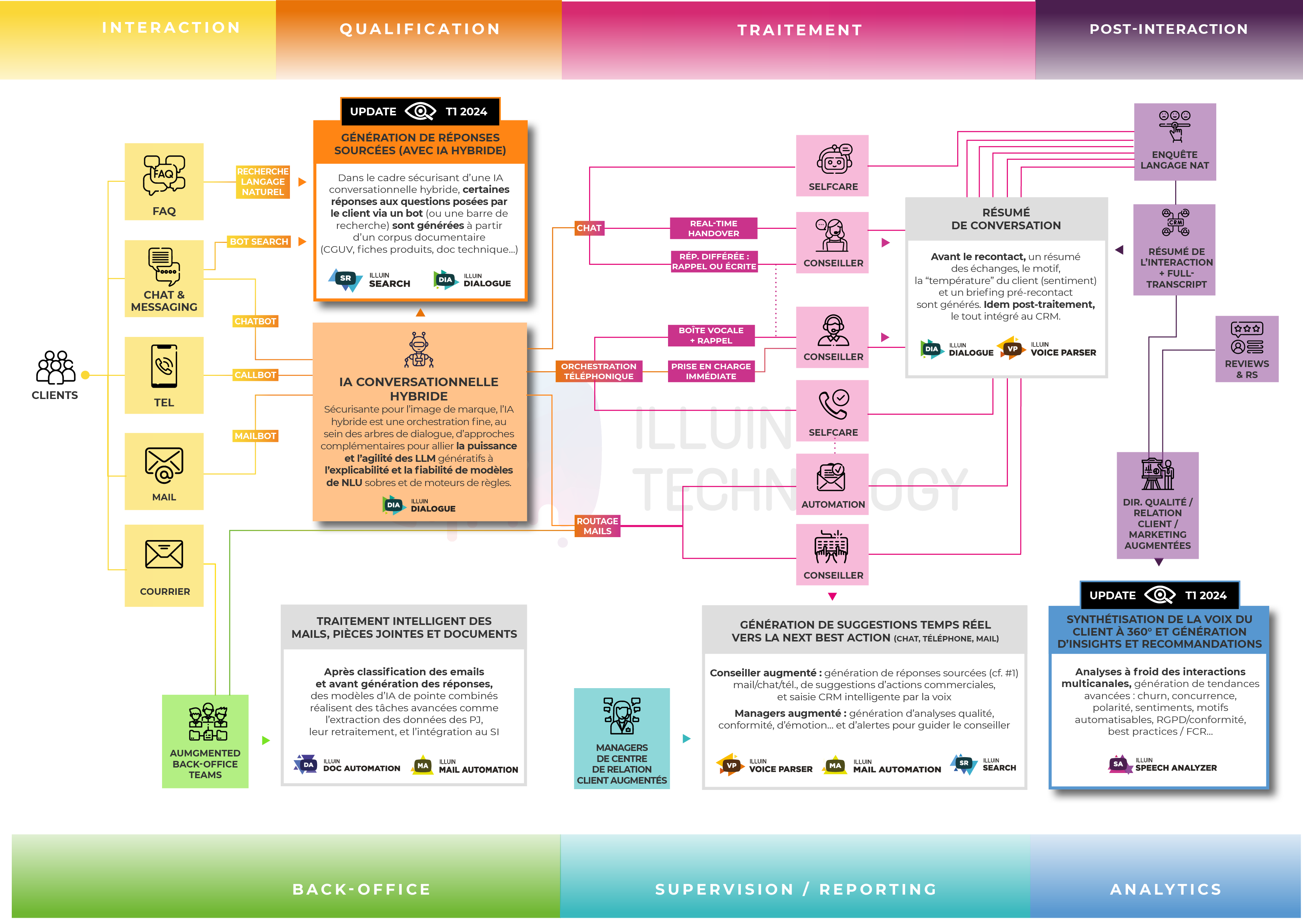
#1 - Generating sourced responses
The generation of sourced answers enables an AI model to write its answers based on information contained in a corpus of documents, and to indicate its sources. A chatbot with this functionality can answer any question by searching for the answer in the source documents, unlike previous chatbots, which were limited to pre-prepared questions and answers. This capability extends self-care coverage, enhances the conversational customer experience, and improves operational efficiency and costs.
#2 - Synthesizing the 360° voice of the customer and generating insights
Generative AI offers a finer understanding of what customers are saying. It can summarize customer exchanges, group them together, give them a title and even make relevant recommendations. This enables continuous discovery of topics that are important to customers, improving responsiveness in terms of personalized marketing campaigns, offer adaptation, and Quality Monitoring in Customer Relations Centers.
#3 - Real-time suggestion generation for the next best action
Advisors can benefit from the generation of sourced answers, suggesting the best answers at each stage of the discussion. This saves time, makes answers more reliable and frees up advisors to be more available to customers. Managers, meanwhile, have access to quality, compliance and sentiment analyses, enabling them to guide advisors towards the best possible resolutions.
#4 - Intelligent handling of e-mails, attachments and documents
Generative AI can generate sourced responses to be sent by e-mail, either automatically or after validation by an advisor. It also improves e-mail routing and the processing of massive attachments managed by the customer service department, such as identity documents, invoices, proof of address, pay slips and contracts.
#5 - The conversation summary
Conversation summaries, made possible by the capabilities of generative LLMs, help advisors to better understand customer needs and adapt quickly. By generating contact patterns, contexts, sentiments and summaries of previous interactions, this technology enriches the company's CRM and provides new data for post-interaction analysis. In conclusion, the adoption of generative AI promises enhanced service quality and personalization, essential in an increasingly competitive market.
Download the complete map 🤩👇